December 2025: F*** Integral Sleeves
December Goals
Garb:
Finish Pad Stitch Test Dress
Finish the first hairnet, maybe make a second.
Classes:
Keep outlining and researching Spanish Women’s Undergarments improvements
Research: The Artifice of Beauty by Sally Pointer
When I sat down to do my November blog post, I realized that I still had never posted the blog post for my Ocean green saya project. So, a year and a half late, that’s up!
First up the Pad Stitch Test Dress:
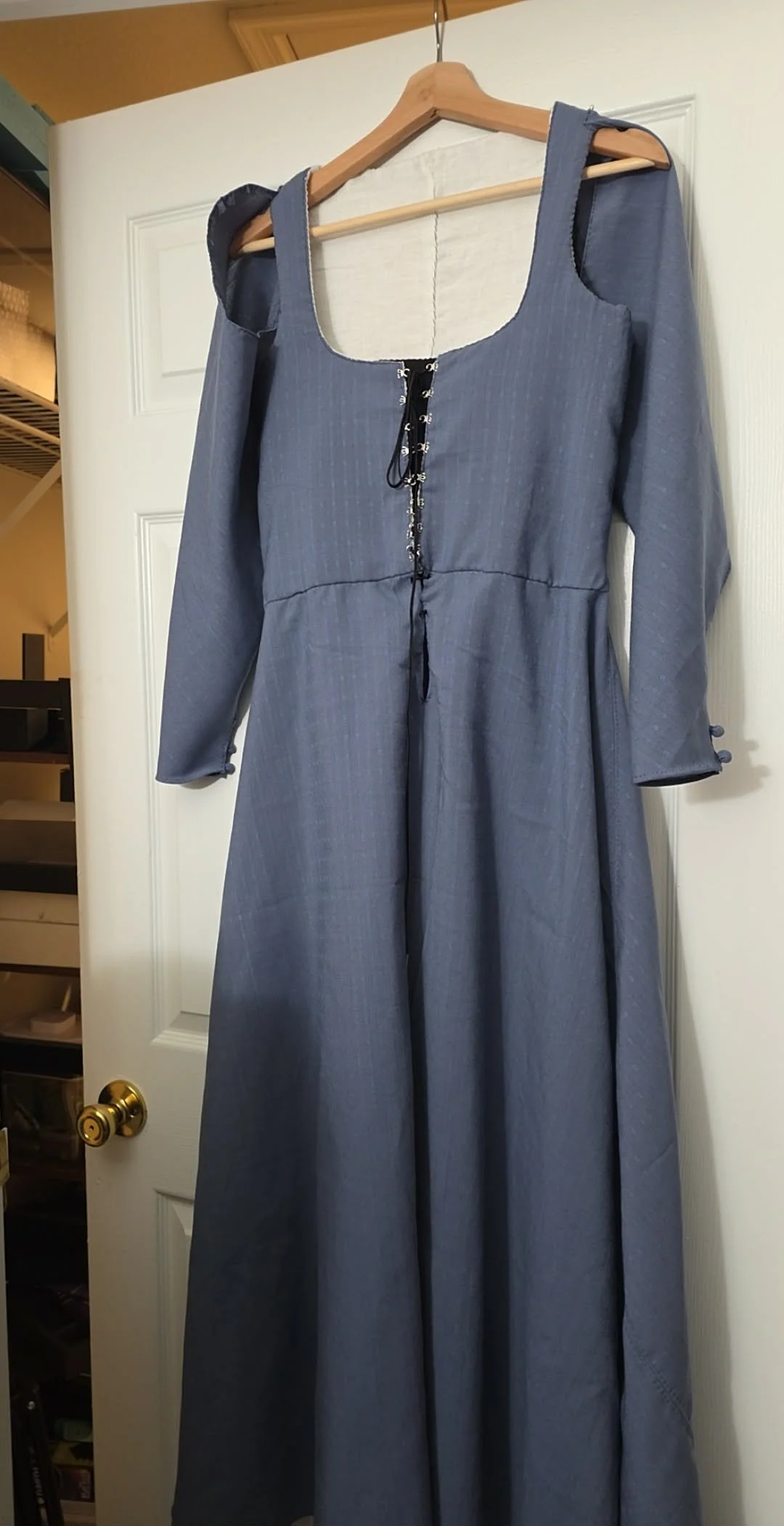
The finished Test Saya outfit.
It got finished this month! It’s a beautiful dress that I am looking forward to wearing at Highland Hearthglow and 12th Night next month. It’s a beautiful color and the drape is gorgeous. I still hate integral sleeves though, and ultimately elected to diverge from the source material to do separate, pin-on sleeves. In total, this dress took 71 hours, 55 minutes over 48 days.
As a learning experience, this dress has been everything I hoped it would be. I got to test out actually doing the techniques, pre-identify several potential pit falls in my design schema, and get comfortable with the fit. There’s aspects of it I find challenging but I think I’m well poised to begin work on the wool one next month with a couple of adjustments. The major change is going to be in the skirt. For Juana’s sobresaya, I’m going to do the skirt in panels with inserted triangular gores. It’s not my favorite way to make skirts, but I think it’s the right path forward.
I’m very glad I made the Test Saya though, because I’d been waffling last month about whether the white part of Juana’s outfit was a sobresaya or the verdugado itself, and having done the Test Saya and reevaluated small detail in the painting, I am back to being convinced it’s a sobresaya over a black saya. In the picture below, there are two areas where the black layer curves upward toward the shoulder straps in a way that hints that that layer also has shoulder straps. It’s because of this that I am back to the black layer being the verdugado.
Which brings us back to our starting place- with a black cotton sateen verdugado, with red silk covers on the bands, and a white sobresaya that I need to cut very, very carefully and do a lot of goldwork on. I don’t mind it, because I had bought the black on sale and had not yet come up with an alternative project that it needed to be, so that’s a bonus!
For next month, starting on actually writing the documentation for this project is a goal as well. It’ll probably just be an outline for January, but I would like to have the paper written slowly throughout the year. I’ve made good progress on the survey of Juana’s style over the years and I think I’ve got a good pin point of where this particular outfit sits in that ecosystem of clothing. The survey needs completion too from more written instead of visual sources next.
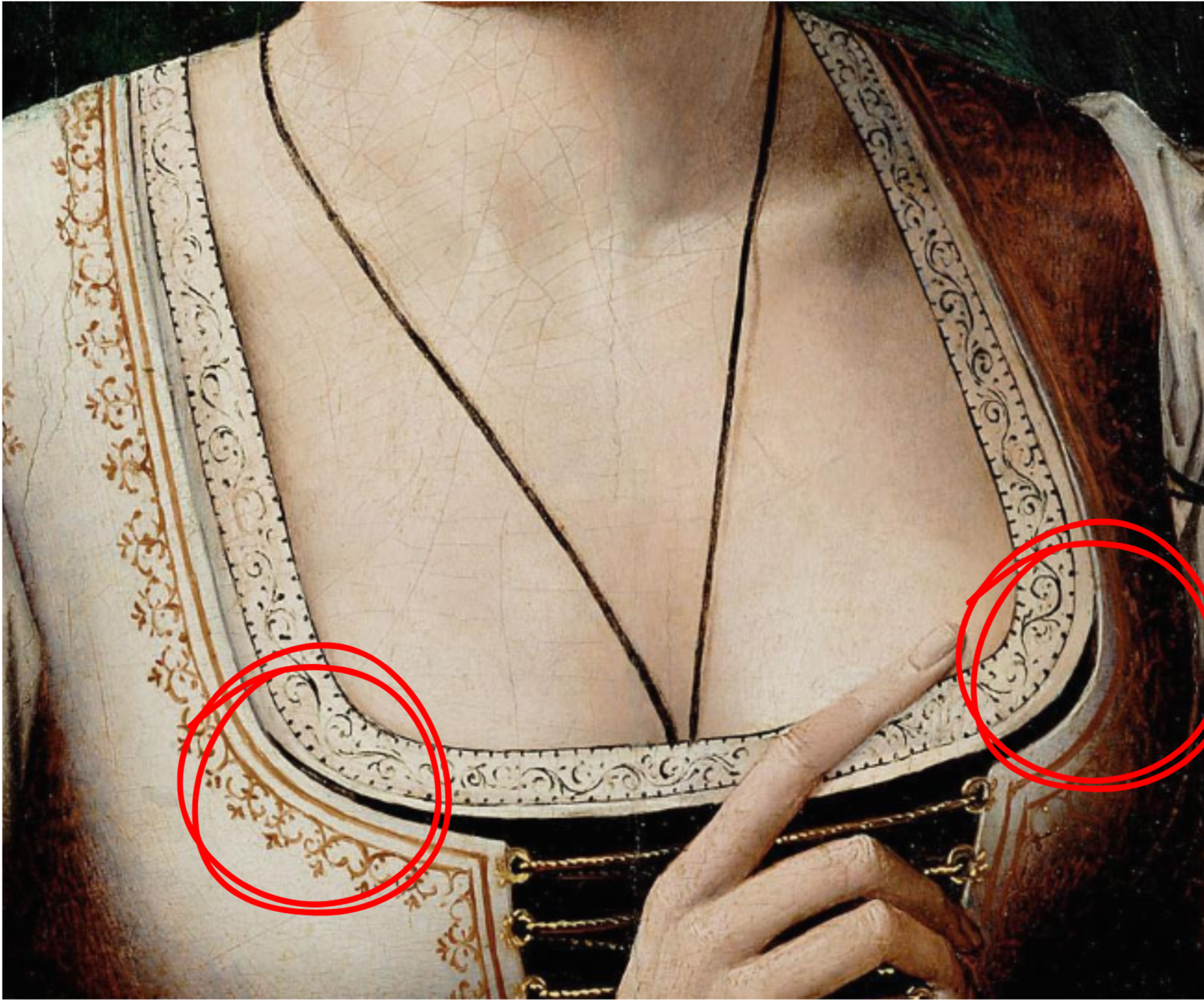
Close up showing the rise in the black fabric hinting at a saya.
So since we’re back to the original plan, I am ready to start moving onto actually making Juana’s outfit I think. Instead of doing the paneled sobresaya, which I am still sure is incorrect due to the front opening, I’m going to aim to do a very precisely cut sobresaya in the same shape as the verdugado skirt beneath it, like in my white whale Salome painting. I think that’s a more realistic choice, but also probably still means goldwork on the hem. In that painting, Salome has her sobresaya tucked up in most frames to show off her verdugado underneath, so it still works.
One thing I’m still struggling a little with is the width of the shoulder straps. To fit the way I want them to, physically, they have to be on the narrower side. I think the width in the painting itself is unreasonably wide- it’s sitting at the point of her shoulder and would hinder any movement significantly. Given that the white dress is still fitted, not loose, it would be very hard to do anything in that dress. There’s three options I see here, and I have not decided which one I’m going to go with yet, though I need to quickly:
Option 1: suck it up and do the wider straps. I could reasonably widen parts of the straps without impeding my own motion too far, but I don’t think I could do the whole way around.
Option 2: keep the straps at my comfortable scale and adjust the armscye embroidery, either by reducing the motif scale or eliminating entirely.
Option 3: pivot and apply the goldwork motif to the sleeves instead. Since I was planning on doing an open back sleeve like the Test Saya, it would likely mean goldwork down both edges of the back seam and around the cuffs too. I’m currently leaning this direction, but I have ample time to make that decision.
For the actual Juana sobresaya, I spent this month coming up with a project plan. I’ll probably complete one phase per month to get the sobresaya done.
Phase 1: Goldwork
Trace pieces onto fabric but do not cut them out, just cut the traced pieces into manageable sized groups.
Apply the interfacing design to the rectangular pieces and baste into place so that they can be put onto the slate frame or in a hoop for gold work.
Do the mountain of goldwork on the bodice, NOT the skirt or the sleeves.
Phase 2: Bodice
Fully complete the bodice of the dress per the notes in the Test Dress sheet, including finishing all open edges.
This phase should include attaching hardware.
Phase 3: Skirt
Complete the skirt construction, finishing the top edge.
Attach skirt to the bodice and adjust the hem.
Baste goldwork pattern to the hem.
Do hem goldwork.
Phase 4: Sleeves
Fully construct and finish sleeves.
Baste goldwork design to the tops, back seam edges, and cuffs.
Do sleeve goldwork.
I did also make the stomacher this month as well! It’s made with two layers of buckram, linen, and wool, and I’m looking forward to trying out this new accessory at 12th Night. I think it’s going to have to be in part pinned into place just for stability, so stay tuned for that experiment.
I finished the hairnet on the 1st, so I’m counting this goal as a success! It’s wearable and comfortable and I’m going to wear it to 12th Night and I’m really looking forward to it. I have some good learning now on things that I need to do better. First off is using actually natural fiber yarns so I can blend my joins instead of having to knot them. The second is I’ve got the size I want down now, so I’m drawing up a pattern that I think will create a more regular/linear diamond pattern, while still making the increases manageable. This is a good size, but the pattern is not neat and if I want to embroider on it, the pattern needs to be neater. I’m going to start on another hair net as a travel/event project and see if I can achieve the look I want to embroider over. It was also a great excuse to revisit my fingerloop skills.
I revisited the original hairnet instructions and have come to the conclusion that they really only work on lace weight yarn. I tried the original poster’s method with fingering and even that was too chunky to cast on half the final stitch number on the starting row and still get a reasonably closed center. I’ve ordered some lace weight of a wool/silk blend in a red that I’m going to try next that may end up being the final product. We’ll see! In the meantime, my designed pattern relies on an even number of increases each row, in the same stitch that was added in the previous row, hopefully to preserve some overall regularity in the grid pattern.
On my underwear class, I’ve got some thoughts about ways to stream line it, but they require some new construction. Instead of a learning path class, I think it could be really interesting to compare and contrast construction decisions now that I’ve got a few styles of both calzas and camisas under my belt. I’ve started the outlining how that might look.
Last but not least, Sally Pointer. I’ve gotten through several sections, mostly outlining the history aspects of cosmetics. I’m looking forward to continuing it next month with some more of the recipes and maybe trying one or two out in February!
January Goals
Garb:
Finish the Green Test Hairnet. Maybe start on the Red one.
Test the Juana Sobresaya lining pattern.
Begin Phase 1 of the Juana Sobresaya.
Classes:
Keep outlining and researching Spanish Women’s Undergarments improvements. Slow and steady!
Re-re-record The Foods That Built Spain
Research:
The Artifice of Beauty by Sally Pointer. I’d love to get it actually finished this month.
Start the outline for the Juana In White documentation.
